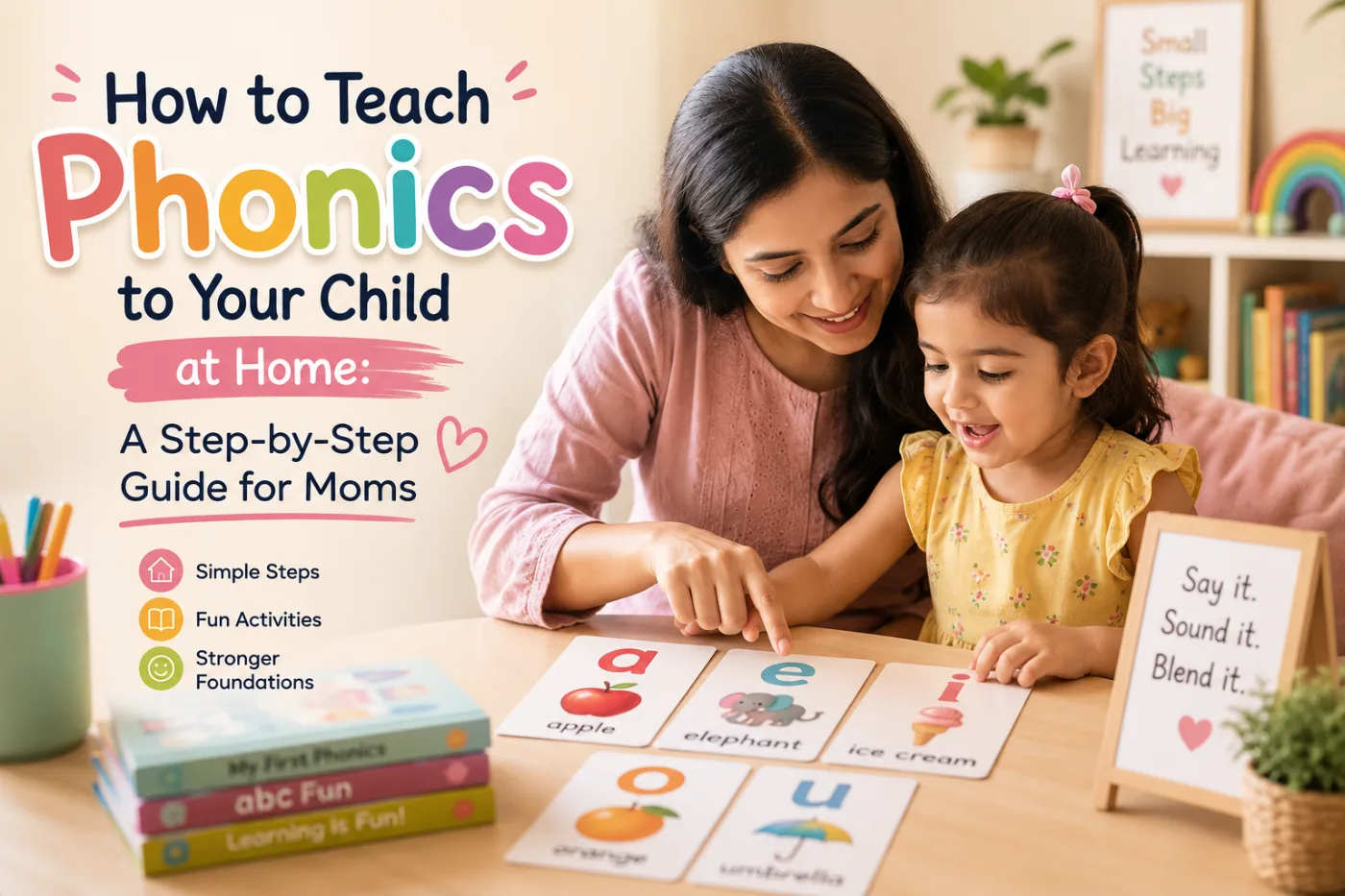
How to Teach Phonics to Your Child at Home: A Step-by-Step Guide for Moms
If you've ever wondered how to teach phonics at home without feeling like you need a teaching degree — you're in exactly the right place. This guide breaks the whole process down into small, manageable steps, with real examples, practice word lists you can start using today, and simple games that make it genuinely fun for your little one.
What's in this guide
What Is Phonics, and Why Does It Matter?
Phonics is simply the relationship between letters and the sounds they make. Instead of asking a child to memorize what every single word looks like, phonics teaches them to decode — to sound words out using the letters in front of them. Once a child understands that the letter "b" makes a /b/ sound and "a" makes an /a/ sound, they can start blending those sounds together to read entirely new words on their own, without needing to have seen them before.
This is exactly why phonics-based reading instruction is the standard approach used across schools in the UK, the US, Australia, and increasingly in India too — it gives children a real, reusable skill for reading, rather than a memorized list of words that runs out the moment they hit something unfamiliar.
The simplest way to think about it
Sight-word memorization teaches a child specific words. Phonics teaches a child how to read any word. That's the whole difference — and it's why phonics instruction pays off long after the early reading stage, well into confident, independent reading.
When Should You Start Teaching Phonics?
There's no single "right" age — every child develops at their own pace — but here's a general, widely-used guide for when most children are developmentally ready for each stage:
If your child is already in school, it's worth asking their teacher what sequence the school follows — reinforcing the exact same order at home (rather than a different one) avoids confusing your child with two competing systems at once.
The 5-Step Phonics Journey
Phonics instruction isn't one skill — it's a sequence of skills, each one building on the last, like climbing a staircase. Skipping a step, or moving too fast, is one of the most common reasons kids get frustrated with reading. Here's the full sequence at a glance:
The Phonics Staircase
Awareness
Recognition
(CVC Words)
Blends
Fluency
How to Teach Phonics at Home, Step by Step
Step 1: Build Phonemic Awareness First (No Letters Yet)
Before your child ever looks at a letter, they need to learn to hear and play with sounds. This is purely auditory — it happens through talking, singing, and listening, not reading.
- Rhyming games — say a word like "cat" and ask your child to think of words that rhyme with it (hat, bat, mat)
- Clapping syllables — clap once for each syllable in a word ("ba-na-na" = 3 claps)
- "I Spy" with sounds — "I spy something that starts with /m/" instead of a letter name
Spend just 10-15 minutes a day here before moving on — this foundation makes everything after it easier.
Step 2: Introduce Letter Sounds (Not Letter Names Yet)
Here's a detail many parents miss: teach the sound a letter makes before its alphabet name. A child needs to know "a" says /a/ (like in "apple") far more urgently than they need to know it's called "ay." Start with a small set of common, useful letters rather than working through the alphabet in order — letters like s, a, t, p, i, n let you build real words almost immediately, which keeps kids motivated.
Step 3: Blend Sounds Into Simple Words (CVC Words)
Once your child knows a handful of letter sounds, it's time for the moment phonics really "clicks" — blending. This is where they combine individual sounds into a whole word. Start with CVC words (consonant-vowel-consonant) — the simplest, most predictable word pattern in English.
How Blending Works
Practice this out loud together: say "/c/ ... /a/ ... /t/" slowly, then say it faster and faster until the sounds blend into "cat." This is genuinely the core skill of early reading — once it clicks, everything after it moves much faster.
Step 4: Add Digraphs and Blends
Once CVC words feel comfortable, introduce digraphs (two letters, one sound — like "sh," "ch," "th") and blends (two letters, both sounds heard — like "bl," "st," "fr"). These unlock a huge new range of words: ship, chin, that, blue, stop, frog.
Step 5: Sight Words and Reading Fluency
Not every word in English can be sounded out perfectly (think "the," "said," "was") — these are called sight words, and they genuinely do need to be memorized alongside phonics, not instead of it. Introduce a small handful at a time (4-5 per week), and keep reading real books together daily — that combination of phonics skills plus a growing sight-word bank is what turns "sounding out" into fluent, confident reading.
Practice Word Sets You Can Use Today
Here are ready-to-use word lists, organized by stage. Print these out, write them on flashcards, or just say them out loud together — no prep required.
🔤 Set 1: Simple CVC Words (Short "a" and "o")
🔤 Set 2: CVC Words (Short "i", "e", "u")
🔤 Set 3: Digraph Words (sh, ch, th)
🔤 Set 4: Blend Words (bl, st, fr, gr)
How to use these sets: pick one set at a time, and don't move to the next until your child can read most of the current one comfortably and confidently. Little, frequent practice (10 minutes daily) beats one long session a week, every time.
5 Simple Games That Make Phonics Fun
- Fridge Letter Hunt — scatter magnetic letters on the fridge, call out a sound, and race to find the matching letter
- Sound Bingo — make a simple bingo grid of letters; call out sounds instead of letter names
- Word Building Blocks — use alphabet blocks or letter tiles to physically build CVC words from the practice sets above
- I Spy Sounds — "I spy something starting with /b/" turns any car ride or walk into practice
- Rhyme Time Stories — read a rhyming book, then pause before the rhyming word and let your child guess it
Make Practice Time Feel Like Play
Our hands-on educational toys are designed to turn exactly this kind of learning into something kids actually look forward to.
Shop Educational ToysCommon Mistakes to Avoid
- Teaching letter names before sounds. Knowing a letter is called "em" doesn't help a child read "mat" — the sound does.
- Moving too fast. If your child is struggling with a set, that's a sign to slow down and repeat it, not push forward.
- Skipping phonemic awareness. Jumping straight to letters without the listening foundation makes blending much harder later.
- Making it feel like a test. Frustration is the biggest thing that turns kids off reading — keep sessions short, playful, and pressure-free.
- Inconsistent practice. Ten minutes daily builds real skill; one long weekly session mostly just builds forgetting in between.
Frequently Asked Questions
Phonemic awareness activities (rhyming, listening games) can start as early as age 2-3, with no letters involved yet. Formal letter-sound instruction typically begins around age 4-5, when most children are developmentally ready.
Every child is different, but with consistent short daily practice, many children move from letter sounds to reading simple CVC words within a few months, and toward more fluent reading over the following one to two years as they add digraphs, blends, and sight words.
This is common, and usually means it's worth going back to Step 1 (phonemic awareness) briefly, even if letters are already familiar. Blending is fundamentally a listening skill before it's a reading skill — strengthening that foundation often unlocks blending quickly.
Phonics first. Sight words are best introduced gradually alongside phonics once basic blending is underway, not as a replacement for it — relying on sight words alone leaves children unable to decode new, unfamiliar words.
Sources & Further Reading
- SplashLearn. "How to Teach Phonics to Kids: 6 Effective Ways."
- Kokotree. "How to Teach Phonics Step by Step."
- Owl Tutors. "Teach Phonics: A Step-by-Step Guide."
- Sarah's Teaching Snippets. "How to Teach Phonics to Your Child at Home."
- Advanced Learning Centre. "14 Steps Approach to Learn Phonics at Home."